


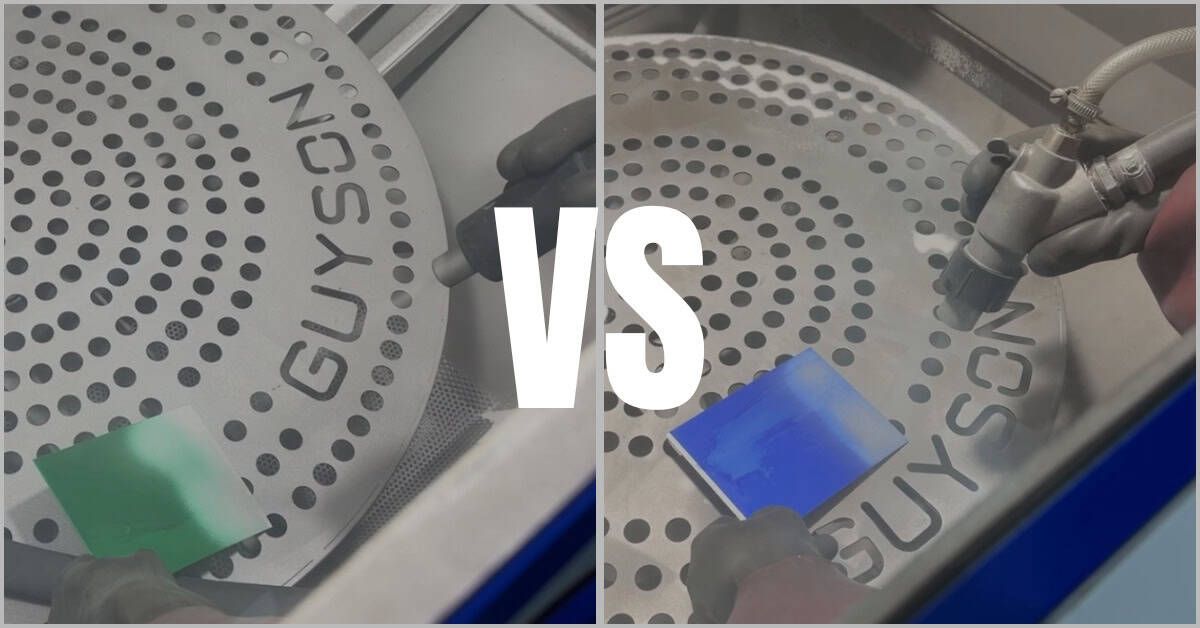
Qualification du processus : avez-vous besoin d’un système à succion ou à pression ?
Depuis plus de 85 ans, Guyson conçoit et fabrique des équipements de finition de surface haut de gamme pour ses clients du monde entier. La gamme s’étend des petites machines manuelles, telles que leurs systèmes d’établi Formula et Pencil Blaster, jusqu’à leurs systèmes de grenaillage de précontrainte informatisés AMS2432, leaders sur le marché.
Bien que chaque système de la gamme Guyson reflète le même engagement envers une technologie de précision offrant des résultats de pointe, une question clé se pose lors de la sélection de la cabine idéale pour votre application de finition, vos exigences de production et vos besoins budgétaires… avez-vous besoin d’un système à succion ou à pression ?
Le choix correct entre une cabine à succion ou à pression a une influence fondamentale sur le résultat final, tout comme d’autres aspects tels que le type de buse du pistolet de sablage et l’abrasif utilisé.
Ces deux types de systèmes peuvent sembler similaires de l’extérieur ; cependant, ils fonctionnent fondamentalement de manières différentes.
Comparaison des performances
|
Vitesse de sablage |
Puissance |
Efficacité (air/abrasif) |
Application |
Maintenance |
|
|---|---|---|---|---|---|
|
Alimentation par succion |
Moyenne |
Moyenne |
Inférieure |
Finition à usage moyen |
Facile à entretenir |
|
Alimentation par pression |
Haute vitesse |
Usage intensif |
Supérieure |
Production industrielle élevée |
Utilisation de composants plus résistants à l’usure |
Systèmes à succion : une puissance légère pour une finition légère
Dans les systèmes à succion, l’abrasif est aspiré de la trémie de la cabine vers le flux d’air par un vide créé à l’intérieur du pistolet de sablage, ce qui entraîne le siphonnage du média à travers le système plutôt qu’une alimentation forcée. Par conséquent, une cabine à succion crée un impact plus doux sur le composant et nécessite donc moins de maintenance des pièces d’usure qu’une cabine à pression.
De plus, les systèmes à succion sont idéaux pour les ateliers à usage moyen, travaillant sur des applications qui exigent de la précision plutôt que de la puissance, comme la finition aux billes de verre, le nettoyage léger et la gravure.
Systèmes à pression : une puissance intensive pour les applications industrielles
En comparaison, un système à pression stocke le média de sablage dans un réservoir sous pression externe. L’abrasif est ensuite introduit dans un flux d’air comprimé à l’intérieur du tuyau de sablage, créant une expérience de sablage plus efficace grâce à la vitesse de sortie plus élevée du média.
Offrant des temps de cycle jusqu’à quatre fois plus rapides que les cabines à succion, le système à pression est le choix privilégié pour les applications de finition de grande production nécessitant puissance et rapidité, telles que l’élimination de la rouille, de la calamine et des résidus de moulage sur les composants.
Qualification du processus à succion ou à pression
Pour tester par vous-même quel type de système convient le mieux à vos besoins de sablage, soumettez vos composants au service d’essai et d’évaluation gratuit et sans engagement de Guyson. Leur service de pointe excelle dans la qualification des processus et les recommandations personnalisées pour soutenir les prises de décision critiques. Contactez l’équipe Guyson dès aujourd’hui pour en savoir plus.